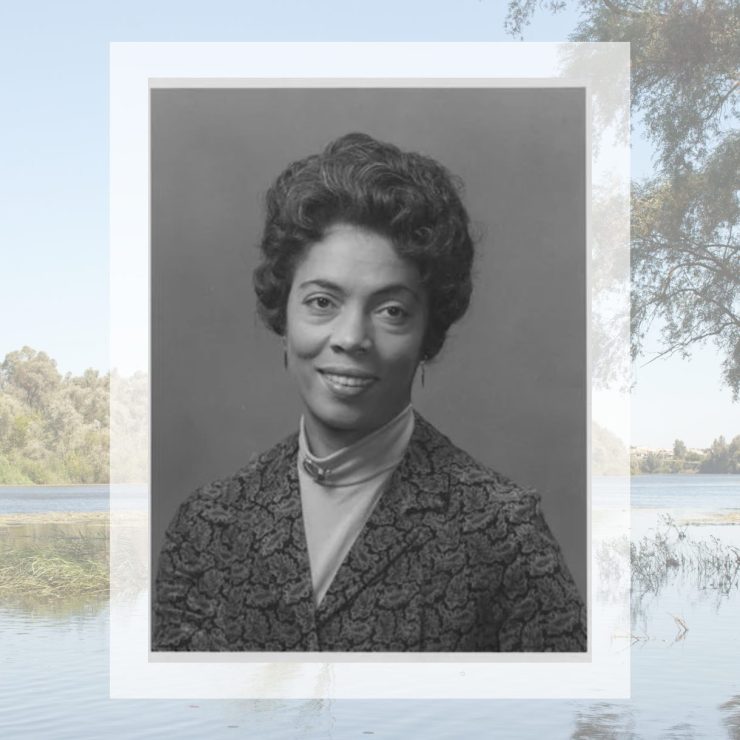
With International Day of Women and Girls in Science passing earlier this week, our second Black History Month spotlight will be highlighting Marguerite Thomas Williams – the first Black person in the United States to earn a PhD in geology! A native of the DC-metro area, her foundational research on erosion and sedimentation within the Anacostia River Basin remains relevant to modern stormwater management practices and watershed protection efforts.
Marguerite Thomas Williams was born on December 24,1895 in Washington, DC as the youngest of five siblings. Not much is known about her childhood, but her passion for nature and geology began at a young age, leading her to pursue a career in the sciences. Williams attended the ‘Normal School for Colored Girls’ (later renamed Miners Teachers College and now the University of the District of Columbia) and graduated from a two-year teaching program for women in 1916. Her high grades earned her a scholarship to Howard University, where she continued her education while working full-time as an elementary school teacher. She graduated with her bachelor’s degree in 1923 and afterward returned to Miners Teachers College to work as an assistant professor and Chair of the Division of Geography, teaching classes and helping with the campus theatre group. After a few years in this position Williams left to continue her studies, earning her master’s degree in Geology from Columbia University in 1930.
With her passion for educating growing alongside her passion for the sciences, she briefly returned to teach at Miners Teachers College before enrolling in a doctoral program at the Catholic University of America. Her research focused on the Anacostia Drainage Basin, which had dealt with major flooding and erosion in the early 20th century. She conducted field work and detailed research to understand the leading factors and impacts of this damage, and in 1942 successfully defended her dissertation, The History of Erosion in the Anacostia Drainage Basin. Her investigation led her to the conclusion that aside from natural erosional processes, human activities such as urbanization and deforestation were large contributors to the erosion in the Anacostia River. In addition to making history as the first African American to earn a PhD in Geology, Marguerite Thomas Williams was also one of the first geoscientists to study how human actions can influence processes of erosion and flooding. After receiving her doctorate, Williams was promoted from assistant to full professor at Miners Teacher College and began teaching night classes at Howard University, holding both positions until she retired in 1955.
Marguerite Thomas Williams passed away in 1991 at the age of 95. She dedicated her career to scientific discovery and mentoring the next generation of geoscientists. Her historic academic milestone forged a path for future African American students seeking doctoral degrees in the geoscience field, and her pioneering research on erosion and sedimentation helped scientists begin to understand how urban development and land use influence flooding and erosion in local watersheds. These insights are still central to the work we do today, demonstrating the profound impact of her legacy. As we celebrate Black History Month, we are proud to remember Marguerite Thomas Williams and the many incredible contributions of women and girls in science!